Nohena Insights · Trade finance
The Africa trade finance gap and its impact on SMEs
The Africa trade finance gap, now over $100 billion, severely limits SME participation in global trade. It is driven by the retreat of correspondent banks and high compliance costs for lenders.
Nohena · 22 November 2026 · 7 min read
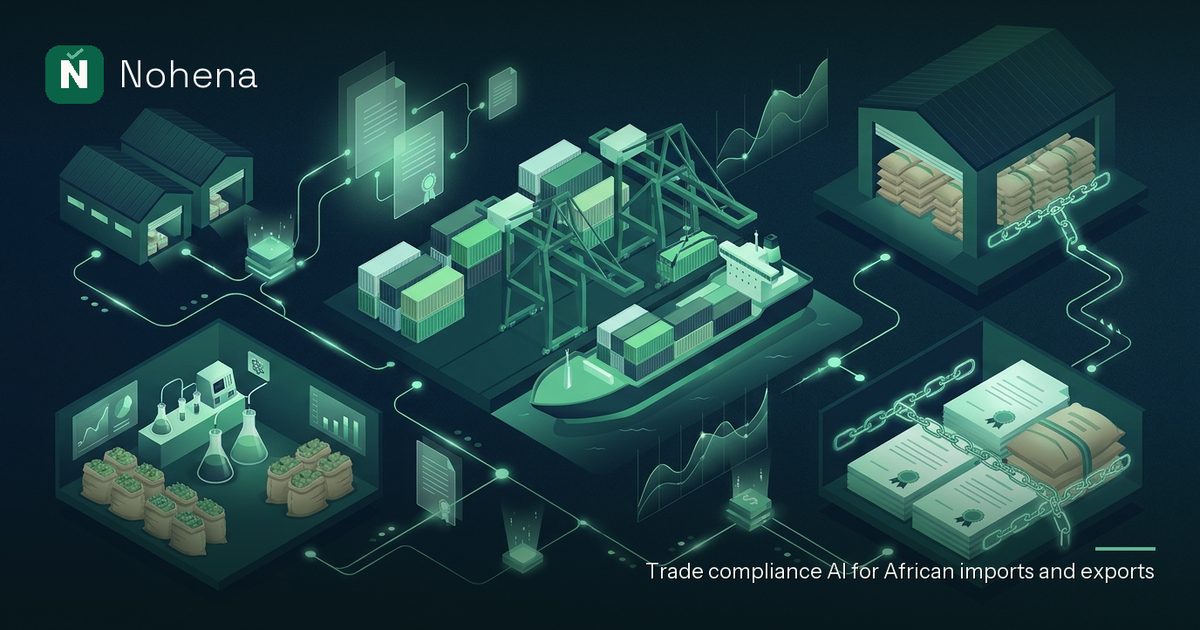
How the Africa trade finance gap affects small and medium businesses
The Africa trade finance gap, which now exceeds $100 billion annually, severely limits SME participation in global trade by making it harder and more expensive for them to access the capital needed to import inputs or finance export sales. This shortfall between the demand for and supply of trade finance is not merely a statistic; it represents a significant barrier to growth for the small and medium-sized enterprises (SMEs) that form the backbone of the continent's economies.
What is the Africa trade finance gap?
The Africa trade finance gap is the unmet demand for trade finance, representing the difference between the financing requested by businesses and the amount approved and disbursed by banks and financial institutions. According to the African Development Bank's (AfDB) 2023 Trade Finance in Africa Survey, this gap widened to an estimated $102.6 billion in 2021, up from around $81 billion before the pandemic. This figure reflects the value of trade finance applications that are partially or fully rejected. For many SMEs, this means cancelled orders, lost opportunities, and stalled growth.
Why SMEs are disproportionately affected
SMEs are hit hardest by the finance gap because they often lack the long credit histories, substantial collateral, and administrative capacity that traditional lenders require for due diligence. Banks, when evaluating a transaction, are managing their own risk. They look for certainty and predictability, which can be challenging for them to find in smaller enterprises. The reasons are systemic.
Perceived risk. Financiers often view SMEs as a higher credit risk compared to large corporations. This perception is based on smaller balance sheets, higher vulnerability to market shocks, and what is often seen as a less established track record.
Collateral requirements. Traditional lending, including many forms of trade finance, is secured against assets. Many SMEs do not own the kind of fixed assets, such as land or buildings, that banks typically demand as collateral for financing.
Documentation and compliance costs. The cost and complexity of due diligence for a bank can be nearly the same for a $50,000 transaction as for a $5 million one. This makes smaller SME transactions less profitable for lenders to underwrite. Furthermore, the documentary requirements for instruments like Letters of Credit, governed by the Uniform Customs and Practice for Documentary Credits (UCP 600), are exact. A minor discrepancy can lead to rejection by the bank, a risk many SMEs cannot afford.
Information asymmetry. This is perhaps the most significant factor. Lenders have limited visibility into the SME's actual trade operations. They cannot easily verify the quality of the goods, the status of the shipment, or the reliability of the end buyer. This lack of verifiable information creates uncertainty, which translates into a higher cost of capital or an outright rejection of finance.
The structural causes of the financing shortfall
The gap is driven by deep structural factors, primarily the retreat of global correspondent banks from the continent and increasingly stringent global regulatory requirements. These are macro-level trends that local banks and their SME customers have little power to change. Key drivers include:
The decline of correspondent banking relationships (CBRs). Correspondent banks are large, international banks that provide services, such as clearing foreign currency transactions, to smaller, local banks in other countries. In recent years, many of these global banks have reduced their relationships in Africa in a process known as 'de-risking'. This is a reaction to the high cost of complying with international Anti-Money Laundering (AML) and Counter-Financing of Terrorism (CFT) regulations. With fewer CBRs, the ability of local African banks to finance international trade, especially in US dollars or euros, is significantly constrained.
Stringent regulatory capital requirements. Global banking regulations, such as the Basel III framework, require banks to hold more capital against their assets, including trade finance portfolios. This makes trade finance a less attractive business line for some banks, further tightening supply.
Macroeconomic volatility. Currency fluctuations, high inflation, and sovereign debt concerns in several African markets increase the perceived risk for both local and international financiers, leading them to be more cautious in their lending.
How a verifiable record can help bridge the gap for an individual exporter
An exporter can improve their access to finance by creating a verifiable, lot-by-lot record of performance that gives a lender confidence in the specific transaction being funded. While an SME cannot change global banking regulations, it can directly address the problem of information asymmetry. By building a comprehensive and transparent record for each export lot, a business moves from being a 'story' a financier has to believe to a 'track record' a financier can verify. This de-risks the transaction in the eyes of the lender.
Nohena prepares such a consented, read-only record for the financier an exporter chooses. The financier makes the final decision. A strong record that anticipates a lender's questions should include:
The commercial foundation. This starts with the sales contract, clearly defining quality parameters (e.g., nut count for cashews, moisture content for cocoa), quantity, price, and payment terms under a specific Incoterms rule.
Pre-export verification. This is the evidence that the goods exist and meet the contract. For agricultural exports, this means lab test results for quality and safety from an accredited ISO/IEC 17025 laboratory. For exports to the European Union, this includes testing for pesticide residues against the EU's MRL database and contaminants like mycotoxins against the limits in Regulation (EU) 2023/915. This data demonstrates the goods are less likely to be rejected at the destination.
Regulatory compliance pack. This is proof of meeting all of Nigeria's exit requirements. It includes the properly declared Form NXP on the Central Bank of Nigeria's (CBN) Trade Monitoring System (TRMS), evidence of payment of the 0.5% Nigeria Export Supervision Scheme (NESS) levy, the phytosanitary certificate from NAQS, and any grading certificates from the Federal Produce Inspection Service (FPIS).
Control of the asset. For pre-export finance or warehouse receipt finance, verifiable documents like warehouse receipts are critical. They prove that a specific quantity and quality of a commodity exists and is under the control of a trusted third party.
Performance history. A consistent, auditable history of successful exports, with goods accepted at their destination and proceeds repatriated within the CBN's 180-day deadline, is powerful. It demonstrates reliability and execution capacity.
By assembling this data for each transaction, an exporter provides the transparency a financier needs to assess the real risk, not the perceived risk. This is a crucial step in gaining access to capital from institutions like the Nigerian Export-Import Bank (NEXIM) or other commercial lenders focused on structured trade and commodity finance. Explore more insights on trade compliance at our insights page .
Nohena prepares. You, or your licensed agent, lodge and export.
FAQ
What is trade finance?
Trade finance is a specialised area of finance that includes the financial products and instruments used by companies to facilitate international trade. It helps mitigate the unique risks involved, such as non-payment by a buyer or non-delivery of goods, and helps manage cash flow through instruments like letters of credit, pre-export finance, and export credit insurance.
Why did the Africa trade finance gap widen?
The gap widened primarily due to a combination of increased demand for goods as economies recovered from the pandemic and a reduced supply of finance. This reduction was caused by global banks scaling back their correspondent banking relationships in Africa to de-risk, coupled with the high cost of compliance with stricter global financial regulations.
How can an SME in Nigeria improve its chances of getting trade finance?
An SME can improve its chances by meticulously preparing all trade documents, such as the Form NXP, and providing independent, third-party verification of its goods, like lab reports from accredited labs. Proving compliance with both Nigerian rules (NEPC, NAQS) and destination market requirements (e.g., EU MRLs) in a transparent, auditable transaction history can significantly de-risk the proposal for a potential lender.
What is a correspondent bank?
A correspondent bank is a financial institution that provides services on behalf of another financial institution, typically in another country. These services are essential for processing international payments and confirming letters of credit. The reduction in these relationships, known as de-risking, has constrained the ability of local African banks to finance trade in foreign currencies.