Nohena Insights · Trade finance
How Nigerian exporters can bridge the trade finance gap
Bridging the trade finance gap requires Nigerian exporters to build a verifiable, transaction-level record of performance and compliance, reducing perceived risk for financiers.
Nohena · 19 November 2026 · 9 min read
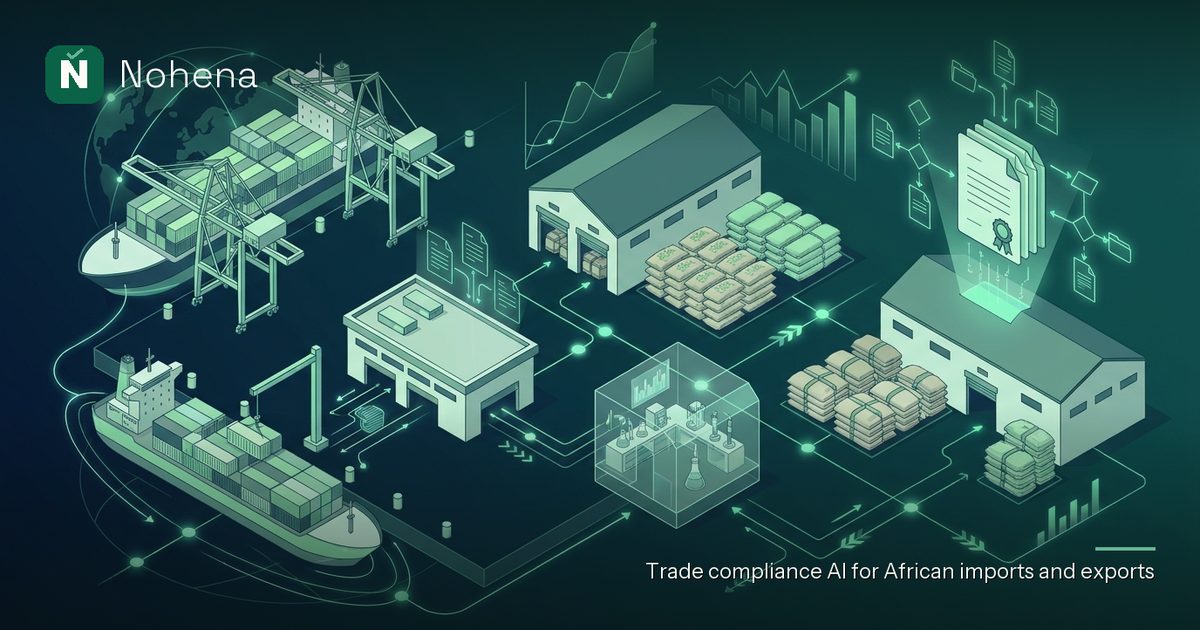
How exporters can bridge the trade finance gap
Bridging the trade finance gap requires Nigerian exporters to build a verifiable, transaction-level record of performance and compliance, which reduces the perceived risk for financiers and makes a stronger case for funding. This record allows financiers to assess specific transactions on their merits, moving beyond a sole reliance on traditional balance sheets and fixed asset collateral.
The African Development Bank (AfDB) has consistently highlighted the significant unmet demand for trade finance across the continent. This trade finance gap in Africa disproportionately affects small and medium-sized enterprises (SMEs), which are the engine of Nigeria's non-oil export growth but often struggle to secure the capital needed to fulfil international orders. For financiers, the core challenge is not a lack of capital, but a lack of visibility into the risk of a given transaction. By creating a transparent, data-rich record for every export lot, from the sales contract to the final repatriation of proceeds, exporters can directly address this information asymmetry and improve their access to finance. Nohena prepares a consented, read-only record for the financier the exporter chooses; the financier decides.
What causes the trade finance gap in Africa?
The export finance gap for Nigerian SMEs is primarily caused by a lack of verifiable data on their operational capacity, compliance history, and transaction performance, which makes it difficult for financiers to assess and price risk accurately.
Financiers must weigh the potential return of a transaction against its risks. Without clear, structured data, they often default to a more conservative stance, leading to rejected applications or prohibitively expensive credit. The key drivers of this gap include:
Information asymmetry. Lenders often lack granular visibility into the exporter's operations. They cannot easily verify the quality of goods in a warehouse, the status of a phytosanitary inspection, or whether the packing list matches the commercial invoice to the kilogram. This uncertainty increases their perceived risk.
High perceived risk. Exporting agricultural commodities from Nigeria involves multiple risks. These include price volatility, counterparty default at the destination, logistical delays, and the potential for rejection at the border due to non-compliance with standards like the EU's maximum residue levels (MRLs) for pesticides. A single rejection can wipe out the profit on multiple successful exports.
Traditional collateral requirements. Many conventional lending models require fixed assets, such as real estate, as collateral. SME exporters' most valuable assets are often the commodities they intend to export, which are considered working capital and not fixed collateral.
Documentation and compliance challenges. International trade finance, particularly under instruments like Letters of Credit (LCs) governed by UCP 600 rules, operates on a principle of strict compliance. Even minor discrepancies between documents, such as the Form NXP, bill of lading, and commercial invoice, can lead to payment delays or refusals, creating risk for the financier.
High due diligence costs. The cost for a bank's trade desk to perform thorough due diligence on many small-value export transactions can be disproportionately high. It is often more cost-effective for them to finance a single large transaction than dozens of smaller ones, leaving SMEs underserved.
How a verifiable record reduces risk for financiers
A verifiable, lot-by-lot digital record of an export transaction, from contract to final payment, allows financiers to assess performance risk based on data rather than relying solely on traditional collateral.
Instead of viewing an exporter as a single entity with a balance sheet, a data-driven approach allows a financier to underwrite a specific transaction. A strong record provides evidence of an exporter's ability to execute. This record should contain:
A complete document set. This includes the sales contract, the proforma invoice, the Nigerian Export Proceeds Form (Form NXP), and evidence of registration with the Nigerian Export Promotion Council (NEPC).
Verifiable quality control. For each lot, the record should include quality analysis from an accredited laboratory (e.g., ISO/IEC 17025 certified). For agricultural goods, this means reports on moisture content, nut count, or outturn analysis, and tests for mycotoxins or pesticide residues against the destination's limits, such as the EU's default MRL of 0.01 mg/kg.
Evidence of regulatory compliance. The record must show that all Nigerian export requirements are met. This includes payment of the 0.5% NESS levy on the Free on Board (FOB) value, the NAQS phytosanitary certificate, and grading by the Federal Produce Inspection Service (FPIS), where applicable.
Traceability through the supply chain. Documents like warehouse receipts, transport logs, and ultimately the bill of lading should connect a specific lot of goods from storage to the port, confirming its identity and quantity at each stage.
A history of performance. Over time, a record of successful exports, confirmed by evidence of acceptance at the destination and repatriation of proceeds within the Central Bank of Nigeria's (CBN) 180-day mandate, becomes a powerful asset. It demonstrates a history of execution.
With the exporter's consent, Nohena shares a read-only, lot-by-lot record with the exporter's chosen financier. By preparing a complete and verifiable pack, the platform enables the financier to make their own, better-informed decision on funding.
Key financing instruments for Nigerian exporters
Nigerian exporters can access several financing instruments, each suited to different stages of the export cycle, including pre-export finance, post-export finance, and instruments that mitigate payment risk.
Pre-export finance
This type of funding is provided before goods are exported. It helps cover the costs of sourcing raw materials, aggregation, processing, and packing. It is often the most critical and hardest to secure form of finance for SMEs.
Warehouse receipt financing. An exporter can use goods stored in a certified third-party warehouse as collateral. The warehouse receipt is a document of title, and the financier can place a lien on the goods, providing security for the loan.
Packing credit. This is a loan advanced against a confirmed export order or a Letter of Credit. The financier's security is the confirmed future receivable from the foreign buyer.
Post-export finance
This funding bridges the cash flow gap between exporting the goods and receiving payment from the buyer, which can take 30 to 90 days or more.
Invoice discounting or factoring. An exporter sells their unpaid invoices to a financier at a discount. The financier provides a percentage of the invoice value upfront and the remainder (minus their fee) when the buyer pays.
Documentary collection and bills discounting. Under a documentary collection (governed by URC 522), an exporter's bank sends the shipping documents to the buyer's bank and collects payment. The exporter’s bank may be willing to discount the bill, providing funds before the final payment is received.
How to choose a financing instrument
The right instrument depends on the exporter's needs, the trust between buyer and seller, and the underlying transaction. A well-documented transaction record strengthens the case for any of these options.
Development finance institutions like the Nigerian Export-Import Bank (NEXIM) and pan-African banks like Afreximbank play a crucial role by providing direct funding, guarantees, and liquidity to commercial banks to encourage lending to the export sector. For more analysis of trade regulations and finance, visit our insights page .
The role of technology in closing the finance gap
Technology closes the trade finance gap by creating transparent, auditable digital records of trade transactions, which standardises risk assessment for financiers and lowers their cost of due diligence.
Digital platforms are emerging as a key solution to the information asymmetry at the heart of the trade finance gap. Their contribution is not to lend money, but to create the trusted data that enables lending.
Standardised data. By ingesting information from sales contracts, lab reports, warehouse receipts, and regulatory filings, these platforms create a single, standardised 'digital export lot'. This allows a financier to compare multiple opportunities on a like-for-like basis.
Automated verification. Technology can perform initial checks on documents, flagging inconsistencies between a packing list and a bill of lading, or checking a pesticide test result against the destination country's legal limits stored in a database. This pre-checking makes the financier's job easier and faster. See how a record is checked and prepared .
Consented visibility. Through a secure platform, an exporter can grant a chosen financier read-only access to their transaction records. This transparency builds trust and allows for data-driven financing decisions, moving beyond the limitations of the traditional credit appraisal process.
Alignment with global standards. As the world moves towards digital trade, frameworks like the UNCITRAL Model Law on Electronic Transferable Records (MLETR) are creating the legal basis for digital bills of lading and other key documents. Platforms that are built on these principles prepare Nigerian exporters for the future of global trade.
Ultimately, the path to bridging the trade finance gap is paved with better data. For Nigerian exporters, the work begins with meticulously documenting every transaction, proving their capacity and compliance one lot at a time. This creates the verifiable record that gives financiers the confidence to say yes.
FAQ
What is the trade finance gap?
The trade finance gap is the difference between the global demand for financing to support import and export activities and the actual supply of that financing from banks and other lenders. The gap is largest for small and medium-sized enterprises in developing economies.
Why is collateral a problem for SME exporters?
Collateral is a challenge because many SME exporters do not own the fixed assets, like land and buildings, that traditional banks require to secure a loan. Their most valuable assets are the commodities they are exporting, which are considered working capital and are more difficult for lenders to secure and value without specialised structures like warehouse receipt financing.
What is pre-export finance?
Pre-export finance is funding provided to an exporter before goods are shipped. It is used to cover operational costs such as purchasing raw materials, processing, and packaging. This funding is typically secured against the value of the confirmed export contract or the goods themselves.
How does a Letter of Credit (LC) help an exporter?
A Letter of Credit helps an exporter by substituting the credit risk of the buyer with the credit risk of a bank. It is a formal undertaking from a bank to pay the exporter a specified sum of money, provided the exporter presents shipping and commercial documents that strictly comply with the terms set out in the LC, as governed by the Uniform Customs and Practice for Documentary Credits (UCP 600).